Victims of occupational injuries or diseases will be unable to afford a compensation claim or will have to pay the legal costs as a result of a proposed law introduced this week by the government.
The TUC says provisions in the Legal Aid Sentencing and Punishment of Offenders Bill to switch the cost on personal injury cases from those who negligence caused the problem to the victims will not deliver a saving to the government but 'will simply line the pockets of insurers.' The Bill will do away with Conditional Fee (CFA) or 'No Win No Fee' agreements. These currently allow all legal costs, including the solicitor's success fee, to be recovered from the negligent defendant.
Under the proposed new law, the injury or disease victim will be expected to give up 25 per cent of their compensation to meet his or her legal costs, even in cases where the defendant has been grossly negligent. The draft law leaves open the possibility for victims who lose cases to be required to pay legal costs incurred by the employer. The changes have been criticised by unions and work injury and disease victims' advocates.
TUC head of safety Hugh Robertson commented: 'This bill will mean that many workers who suffer an occupational injury or disease will no longer be able to afford to make claims against their employer or, if they do manage to fund a case, will find their damages reduced. It is a blatant assault on victims and will simply line the pockets of insurers.'
Tony Whitston, chair of the Asbestos Victims Support Groups' Forum UK, said dying workers are being 'told that they must carry the risks of suing for compensation', adding 'isn't the risk of losing their lives enough?' He said the reality of the 'shameful attack' is only negligent firms and insurers will benefit from the government proposals. 'The fact is that many frail and terminally ill sufferers will no longer sue for compensation, fearing more uncertainty and stress of litigation,'he said. The union Unite said there were other damaging changes in the proposed law, estimating 650,000 people 'could be denied legal aid and advice to help them with housing, employment and immigration problems.'

29.6.11
PCS INDUSTRIAL ACTION
ALL OUT ON 30th JUNE 2011
Then a Civil Service wide overtime ban throughout July 2011

PCS has done everything possible to negotiate a solution to the Civil Service Compensation Scheme, the Pay Freeze, and our Pensions however to date there has not been an acceptable outcome from the Government.
We have already witnessed over two thousand job losses from the Fylde economy due to the job cuts in the area and even more are now in jeopardy, we have seen our pay frozen (and unlike other areas of the Public Sector our Pay Progression isn’t separately funded meaning that we are treated even more unfairly than other public servants), our Pensions are under attack (we are being expected to pay more for our pensions, work longer and receive less) and our redundancy terms are being cut so that it is cheaper to get rid of us.
We are being asked to pay for the financial mess created by the bankers and the financial speculators and spivs, with our jobs, our pay, our pensions and our conditions of service. The financial mess was none of our making. It’s their financial mess make them pay for it.
It is time for members to show that they oppose the notion of being forced to pay for the excesses of the spivs.
Our reasonable demands are:
Potential Members
If you have not yet joined your Union, please consider doing so and complete the form here and return to Room 7233, Norcross.

The purpose of this post is to inform members of the strike action on the 30th June 2011 to be followed by a Civil Service wide overtime ban.
PCS has done everything possible to negotiate a solution to the Civil Service Compensation Scheme, the Pay Freeze, and our Pensions however to date there has not been an acceptable outcome from the Government.
We have already witnessed over two thousand job losses from the Fylde economy due to the job cuts in the area and even more are now in jeopardy, we have seen our pay frozen (and unlike other areas of the Public Sector our Pay Progression isn’t separately funded meaning that we are treated even more unfairly than other public servants), our Pensions are under attack (we are being expected to pay more for our pensions, work longer and receive less) and our redundancy terms are being cut so that it is cheaper to get rid of us.
We are being asked to pay for the financial mess created by the bankers and the financial speculators and spivs, with our jobs, our pay, our pensions and our conditions of service. The financial mess was none of our making. It’s their financial mess make them pay for it.
It is time for members to show that they oppose the notion of being forced to pay for the excesses of the spivs.
Our reasonable demands are:
- No detrimental changes to our pensions and our redundancy payments
- Application and strengthening on the protocols to avoid redundancy
- An end to the pay freeze and a fair pay rise for all members
JOIN YOUR COLLEAGUES ON STRIKE ON THE 30th JUNE 2011 AND SUPPORT THE FOLLOWING CIVIL SERVICE WIDE OVERTIME BAN THROUGHOUT JULY
Potential Members
If you have not yet joined your Union, please consider doing so and complete the form here and return to Room 7233, Norcross.


Rally for the Alternative - Blackpool!

Blackpool Against the Cuts will be holding a Rally for the Alternative on:
3.30pm, Thursday 30th June
The Rally will be held at St John’s Square, Blackpool Town Centre. Please come along and offer your support for the alternative – Tax Justice, not slashing the terms and conditions of public sector workers.
North West Rallies - 30th June 2011
PCS North West Regional Office has provided details of several rallies being organised in the North West for the strike day taking place on June 30th.
The flyer advertising the events can be found here.
The flyer advertising the events can be found here.
***update***
There is now an event in Blackpool, click here.
There is now an event in Blackpool, click here.
Pensions - Update
Have you checked the online PCS Pensions Calculator?
We urge all members to check the PCS online Pensions Calculator to see how much more you will have to pay, work longer and receive less. The calculator can be found here.
Millions of workers, who were already facing meagre average annual pension income of less than £5,000 in many cases, will have to work longer and pay more for far less in retirement. The calculations used in the PCS Pensions Calculator are taken from government proposals which are based on the Hutton report.
The calculator provides members of the three main civil service schemes: Classic, Premium and Nuvos with estimates of how much the government’s proposed pension changes could cost them between now and their retirement. Many people face a doubling or tripling of contributions and might have to work longer because of the raising of the pension age from 60 to 65 and then to 68. For the average worker that could mean paying an extra £50.00+ a month at a time when there is a pay freeze.
PCS General Secretary Mark Serwotka explains: “These figures show the scale of the pensions’ robbery facing millions of people across the UK. Many people on low incomes will lose money they can ill afford to each month as their contributions could more than double or even triple. Thousands of people will also lose out; because of the switch from RPI to CPI indexation.
The cuts are unnecessary; our pension schemes are affordable and sustainable. The proposed huge increase in contributions will go straight into the coffers of the Treasury to pay off the deficit caused by the finance sector. We need action to stop this pensions robbery, to stop the job cuts, and the pay freeze. There is an alternative: create jobs to grow the economy and collect the £120 billion in tax evaded, avoided and uncollected each year.”
For examples of the extra you may have to pay each month please below:
We urge all members to check the PCS online Pensions Calculator to see how much more you will have to pay, work longer and receive less. The calculator can be found here.
Millions of workers, who were already facing meagre average annual pension income of less than £5,000 in many cases, will have to work longer and pay more for far less in retirement. The calculations used in the PCS Pensions Calculator are taken from government proposals which are based on the Hutton report.
The calculator provides members of the three main civil service schemes: Classic, Premium and Nuvos with estimates of how much the government’s proposed pension changes could cost them between now and their retirement. Many people face a doubling or tripling of contributions and might have to work longer because of the raising of the pension age from 60 to 65 and then to 68. For the average worker that could mean paying an extra £50.00+ a month at a time when there is a pay freeze.
PCS General Secretary Mark Serwotka explains: “These figures show the scale of the pensions’ robbery facing millions of people across the UK. Many people on low incomes will lose money they can ill afford to each month as their contributions could more than double or even triple. Thousands of people will also lose out; because of the switch from RPI to CPI indexation.
The cuts are unnecessary; our pension schemes are affordable and sustainable. The proposed huge increase in contributions will go straight into the coffers of the Treasury to pay off the deficit caused by the finance sector. We need action to stop this pensions robbery, to stop the job cuts, and the pay freeze. There is an alternative: create jobs to grow the economy and collect the £120 billion in tax evaded, avoided and uncollected each year.”
For examples of the extra you may have to pay each month please below:
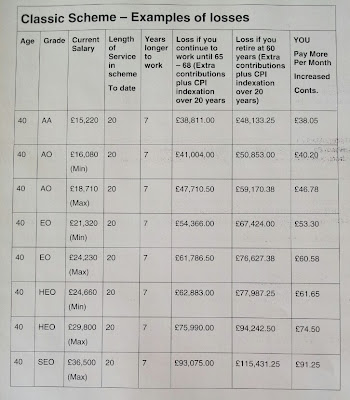 A larger version of the image can be found here.
The above are examples only and use DWP imposed 2011/12 salary rates. Those in the Premium and Nuvos scheme tend to lose even more. Check the PCS Web Site yourself to find out how much you could lose!
23.6.11
NUT Rally - Lancaster
The following has been supplied by NW Regional Office:
Lancaster, Morecambe & District NUT have arranged a couple of events:
Thursday 23rd June
Open Public Meeting at Lancaster Town Hall, 7pm-9pm
Speakers: Kevin Courtney (NUT), Bob Wareing (ATL), UCU, PCS, NHS, etc.
Thursday 30th June
Rally and March; assemble 11am in Market Square, Lancaster with live music, stalls, street theatre, balloons.
All are invited to both events.
The Lancashire NUT website can be found here.
Lancaster, Morecambe & District NUT have arranged a couple of events:
Thursday 23rd June
Open Public Meeting at Lancaster Town Hall, 7pm-9pm
Speakers: Kevin Courtney (NUT), Bob Wareing (ATL), UCU, PCS, NHS, etc.
Thursday 30th June
Rally and March; assemble 11am in Market Square, Lancaster with live music, stalls, street theatre, balloons.
All are invited to both events.
The Lancashire NUT website can be found here.
War on Want - Fest-Watch
 War on Want will be present at many of the festivals across the UK this summer.
For further details check out their page here.
22.6.11
How Much Will YOU Lose?
 PCS have prepared a calculator for the three Civil Service Pension schemes to show how much you will lose over your career (if you have a job) by the changes the Government intend to impose.
The calculators can be found here and it is suggested that everyone uses them to find out exactly how the Governments impositions will effect individuals income both directly in their wage packet and in the future for their pensions.
17.6.11
Pay 2011 Q&A
The members’ meetings on the DWP Pay offer are ongoing here is a questions and answers brief from PCS DWP Group:
Q: I am aware of the Pay Freeze, but how much is the real value of my pay falling?
A: A lot. The rate of inflation for May was 5.2% RPI (4.5% CPI). Set against this almost half of the DWP workforce get no increase and the rest an increase of less than 2.5%. Nobody gets any progression. This is also the fifth year of pay restraint in DWP. Had the EO maximum not been held down since 2007 and then frozen for two years it would be worth over £2,500 more now.
Q: What about the government’s pension changes?
Q: What about the government’s pension changes?
A: In addition to the rapidly rising cost of living members will need to consider the increase in employee pension contribution of at least 3% which the government intends to introduce from April 2012. This will reduce your take home pay by roughly the equivalent of losing a day’s pay every month. For a personal illustration of how this could affect you - use the pension calculator on the PCS website.
Q: Is it true that the non-consolidated end of year bonus now costs more than the pay increase?
A: Yes. The pay offer is worth £30 million and the end of year bonus is worth £52 million. The money is used to allow non-consolidated and non-pensionable payments to be made to staff earning above £21,000 full-time equivalent, but the employer insists it must be performance related. Despite the opposition of the unions it is distributed on the basis of a 2 to 1 share to staff in receipt of “consistently good” and “wholly exceptional” markings. This means the small number receiving the top box marking get twice as much as those whose performance is rated as “consistently good”. This represents a huge increase in the proportion of pay costs that are performance related and sets a very undesirable precedent.
Q: What is the union’s attitude to performance related pay?
A: It is wrong in principle to claim to reward high performance when the money comes out of the pockets of those whose performance is consistently good. Improved performance is only really possible when everyone contributes. A carrot on a stick may be ok for donkeys but not civil servants. In practice performance related pay can be shown to discriminate against staff for other reasons. Full diversity and equality data is not yet available but on the emerging figures seen by pay negotiators there has been little or no improvement in the outcomes which made part-time staff, ethnic minority staff, and staff with a disability less likely to be awarded the top marking last year.
Q: Do all staff with the qualifying box marks get an end of year bonus payment?
A: No. Staff must also be in post on 1st July 2011. This year, significant numbers of staff who can claim to have earned a bonus through their People performance marking are excluded, such as those taking an exit package whose last day of service is 30th June, and anyone terminating at the end of an FTA before 1st July 2011. PCS negotiators have made this point to management repeatedly but to no avail.
Q: Do unsatisfactory performers get a pay award?
A: No. As in previous years in addition to exclusion from the end of year bonus staff marked as unsatisfactory in the 2010/11 People Performance report will not receive any consolidated increase. This applies even if their pay falls below the range minimum. There is provision for the award to be paid if performance improves.
16.6.11
Blackpool Against Cuts
 A reminder that the next meetings of Blackpool Against Cuts are on the 21st and 28th of June, both metings are at the LMS Loco Club, Back Ribble Road, Blackpool, FY1 4AB (map here).
The meetings will run between 6:30 PM and 7:45 PM.
Any agenda items for 21st by the morning of the June 20th please. Agenda items can be sent to Andy Boylan.
15.6.11
It's Yes and Yes - Ballot Results
 The purpose of this post is to inform members of the outcome of the National ballot on the Pay freeze, Civil Service Compensation Scheme, Pensions changes and the campaign to defend members’ jobs, and pay in the Civil Service (including the DWP/ CSA on the Fylde).
The ballot closed on 15th June 2011 and the results were as follows:
Question 1 – Are you prepared to take part in Strike Action
Number of members voting: YES = 61% NO = 39%
Question 2 – Are you prepared to take part in Industrial Action Short of a Strike
Number of members voting: YES = 84% NO = 16%
It is important that members write to their MPs so that they will (hopefully) realise the depth of feeling of the membership. It can make a difference. We have previous circulated model letters on the issues to send to your MP.
You may also want to visit this site which looks at the impact on your pension.
The Branch website will be updated with information during the next stages of the campaign.
We believe it is vital that all members support the campaign and get actively involved.
DWP PAY 2011 - Meetings
 Members Information/Ballot Meetings
The purpose of this post is to advise members of a forthcoming round of information meetings to discuss the DWP pay offer.
The details of the meetings are as follows:
Thursday 16th June 2011
Warbreck Canteen
2:15 pm
Warbreck Canteen
2:15 pm
Friday 17th June 2011
Norcross Canteen
10:00 am
Norcross Canteen
10:00 am
Monday 20th June 2011
Peel Park - The Lecture Theatre
13:30 pm
Peel Park - The Lecture Theatre
13:30 pm
Wednesday 22nd June 2011
Warbreck Canteen
10.00 am
Warbreck Canteen
10.00 am
Carer's Week
 AgeUK promote a carer's week each year. The branch Equal Opportunities Officer has arranged for a stall to be set up at Warbreck House in the canteen providing information on caring related issues members may face and directions in which they can turn for assistance and advice.
More information can be found on the website at the link above.
The Warbreck stalls will be available on the 16th and 17th of June from 11.30am to 2.00pm in the Canteen.
There will be information available on: Maternity Rights, Law on age discrimination, Parental leave, Paternity Leave, Flexible working options, Elder care, Time off for Dependants and Carers and The Equality Bill.
For more information please contact Gloria Hodgkinson by email or on x67714.
National Pensioners Convention
 The NPC have embarked on a campaign to get one of their representatives to appear on Question Time.
You can read more about it here.
The NPC are holding their Pensioner's Parliament from the 14th to the 16th of June, the draft agenda can be viewed below:
NPC Pensioners' Parliament
14-16 June 2011
Draft Programme
Tuesday 14 June
1.00pm
March to the Winter Gardens
2.00-4.00pm
Official opening of the NPC Pensioners' Parliament, Opera House Rally with a range of guest speakers
14-16 June 2011
Draft Programme
Tuesday 14 June
1.00pm
March to the Winter Gardens
2.00-4.00pm
Official opening of the NPC Pensioners' Parliament, Opera House Rally with a range of guest speakers
---
Wednesday 15th June
10.00am-12noon
Question Time with Steve Webb, Pensions Minister followed by panel discussion
Delegates have been asked to send in questions for this session
2.00pm-4.00pm
Older people and the Big Society
This session will discuss the government's Big Society and what it means for older people in light of cuts to public spending
The future of the NHS
This session will consider the changes being proposed to the NHS, what impact they could have on older people and what can be done
Engaging with policy makers across the UK
This session will hear examples from the four countries in the UK of how older people are getting their views across to those in power
Social evening with The Bachelors
---
Thursday 16 June
10.00am-11.30am
Age Equality - are we there yet?
This session will look at the new Equality Act and how it will affect older people
The vision of social care
This session will consider the latest proposals for how care should be funded, the quality of the services people receive, the use of individual budgets and the rights of older people to be protected from abuse
The ongoing campaign for concessionary travel
This session will look at how the government's spending cuts are impacting on services for older people and the campaign to improve public transport
11.45am-12.30pm
NPC Report
The NPC will report on its work and campaigns over the last year and outline what challenges older people face
Keynote Speech: Mark Serwotka, General Secretary, PCS
Important Notice regarding the Branch Hardship Fund
The Branch has set up a Hardship fund to support members who have encountered financial hardship as a result of taking strike action.
The term financial hardship means for example that you need cash for a prescription but no longer have the funds to pay for the prescription.
If you wish to make a claim to the Branch hardship funds then please contact the Branch Office for more information or fill in the hardship fund application form here and send it to the address supplied.
The term financial hardship means for example that you need cash for a prescription but no longer have the funds to pay for the prescription.
If you wish to make a claim to the Branch hardship funds then please contact the Branch Office for more information or fill in the hardship fund application form here and send it to the address supplied.
PCS Opposes DWP’s refusal to pay redundancy compensation to FTA’s

PCS has been arguing that any FTA member of staff, who has 2 or more years service, should be entitled to financial compensation at the time that their contract is ended.
The Civil Service Compensation Scheme rules state:
"As long as the fixed term employee has at least 2 years qualifying service and is being dismissed for redundancy, they will receive the same compulsory compensation terms as a permanent member."
PCS believes that every FTA who has their contract ended at the contract end date, or at the end of any contract extension period, is being dismissed for redundancy. We therefore have put to DWP that every FTA with at least 2 years qualifying service should be entitled to compensation when their contract ends.
Unfortunately DWP has refused to accept this. Instead they have argued that they took FTA’s on to do a set period of work and are terminating the FTA’s at their due contract end date. In legal terms they maintain that this termination at the contract end date isfor ‘some other substantial reason’ and not a redundancy situation. As a result they maintain they do not have to pay redundancy compensation.
PCS does not accept DWP’s position on this issue. We are currently taking legal advice to clarify the position and assess what our next steps should be.
PCS will be issuing further guidance and advice to reps and members as soon as possible.
26.5.11
Blackpool Anti-Racist Vigil
The following has been supplied by Unity:
Meet at 12 Noon at The Headlands, south of Central Pier, Blackpool.
The racist English Defence League is trying to whip up race hatred in Blackpool by exploiting the tragic cases of Charlene Downes and Paige Chivers.As local people opposed to racism, we have called an anti-racist Vigil in response to the EDL’s provocations.
The EDL is a racist group with links to the fascist BNP. It has carried out violent rampages in towns where it has held protests. In Stoke-on-Trent, they attacked Asian people, Asian-owned businesses and overturned cars. Every EDL protest has been accompanied by racist chanting and nazi salutes. Our problems are not a result of race or ethnicity. Racism and scapegoating will leave the community divided and at war with each-other. That is what the EDL wants, and that is why we are holding our Unity Vigil in support of our multi-racial and multi-faith community in Blackpool.
Called by Blackpool & Fleetwood Unite Against Fascism, supported by North West UAF.
BLACKPOOL ANTI-RACIST VIGIL
SATURDAY 28TH MAY
SATURDAY 28TH MAY
Meet at 12 Noon at The Headlands, south of Central Pier, Blackpool.
The racist English Defence League is trying to whip up race hatred in Blackpool by exploiting the tragic cases of Charlene Downes and Paige Chivers.As local people opposed to racism, we have called an anti-racist Vigil in response to the EDL’s provocations.
The EDL is a racist group with links to the fascist BNP. It has carried out violent rampages in towns where it has held protests. In Stoke-on-Trent, they attacked Asian people, Asian-owned businesses and overturned cars. Every EDL protest has been accompanied by racist chanting and nazi salutes. Our problems are not a result of race or ethnicity. Racism and scapegoating will leave the community divided and at war with each-other. That is what the EDL wants, and that is why we are holding our Unity Vigil in support of our multi-racial and multi-faith community in Blackpool.
We urge everyone to attend the Unity Vigil in Blackpool on Saturday 28th May.
Called by Blackpool & Fleetwood Unite Against Fascism, supported by North West UAF.
24.5.11
The following details have been supplied by the PCS HQ:
Campaigning for the alternative
The ‘March for the alternative’ sent a powerful message to the government that many people oppose its cuts programme which attacks jobs, pensions, pay and our communities.
The fantastic event on 26 March galvanised the half a million people who came to London to fight the continuous threats to jobs, detrimental changes to pensions, the pay freeze, further privatisation and cuts in the civil service compensation scheme. The momentum needs to be increased in these unusual and uncertain times in defence of what our grandparents bequeathed us: the NHS, welfare state, free education and decent pensions and holidays.
The PCS national executive has agreed to establish a formal dispute and asked our annual delegate conference, which met in Brighton from 18-20 May, to endorse a national ballot of members in the civil service and non-departmental public bodies on a programme of industrial action.
We won’t accept the cuts
PCS general secretary Mark Serwotka received rapturous applause for his speech to marchers gathered in Hyde Park on 26 March in which he said:
"Imagine what it would be like if we didn’t only march together, we took strike action together across all of our public services."
"And let’s be clear, whether you work in health, in schools, in the civil service, in private industry, wherever you work, we are stronger when we march together, so let’s ensure that we strike together to let the government know we won’t accept it."
The next steps
The union’s national executive agreed unanimously to move a vote for national industrial action over cuts to jobs, pensions and pay. The decision was subject to endorsement of the union’s annual conference as an emergency motion when it opened in Brighton on 18 May. It was agreed the ballot would commence the following week with the first strike possible in June 2011.
The specific aims of the ballot are:
- No detrimental changes to pensions and the civil service compensation scheme
- Application and strengthening of the national protocols on avoiding compulsory redundancy
- An end to the pay freeze and a fair pay rise for all PCS members.
It’s Yes and Yes

We are asking that all members vote “Yes and Yes” in the forthcoming ballot on Jobs, Pensions, Redundancy Terms and for fair Pay as part of the campaign to ensure that we defend members’ jobs, pay, conditions of employment and pensions in the DWP/ CSA/ MOD on the Fylde.
To date we have seen thousands of jobs lost, even more are now in jeopardy, we have seen our pay frozen (and unlike other areas of the Public Sector our Pay Progression isn’t separately funded meaning that we are treated even more unfairly than other public servants), our Pensions are under attack (we are being expected to pay more for our pensions, work longer and receive less) and our redundancy terms are being cut so that it is cheaper to get rid of us.
The Government has declined to give PCS any assurances on our jobs, our pay and our pensions. Our reasonable demands are:
- No detrimental changes to our pensions and our redundancy payments
- Application and strengthening on the protocols to avoid redundancy
- An end to the pay freeze and a fair pay rise for all members
The Branches have also been involved in the March for the Alternative and has written to all the local MPs, we have met several of them and there have been details on the Branch website regarding replies.
It is important that members write to their MPs in order that they will hopefully realise the depth of the feelings. It can make a difference. We believe it is vital that all members support the campaign and get actively involved. If you have not yet joined PCS there is an application on the reverse for you to join.
We are being asked to pay for the financial mess created by the bankers and the financial speculators and spivs, with our jobs, our pay, our pensions and our conditions of service. The financial mess was none of our making. It’s their financial mess make them pay for it.
VOTE “YES AND YES” FOR DISCONTINUOUS STRIKE ACTION AND DISCONTINUOUS ACTION SHORT OF A STRIKE
Jobs, pensions and pay under attack
The following details have been supplied by the PCS HQ:
Improving members pay is always a priority for PCS, along with the defence of well-resourced, democratically accountable public services. The coalition government’s austerity programme of public sector pay freezes and cuts is on a scale never seen before in this country, even under Thatcher.
The think tank Resolution Foundation’s (RF) analysis of Osborne’s 2011 budget offers worrying parallels. Its research has found that those already struggling on low to middle earnings will see their real incomes fall by between 4% and 7% in real terms over the next year. Unlike other analysis since the budget, RF research focuses on middle and low-income groups and factors in not only tax and benefit changes, but also the latest official predictions from the Office for Budget Responsibility on how wages will lag behind increases in the cost of living.
The Institute of Fiscal Studies (IFS) says the pressure on household budgets is the worst since the 1970s. PCS Members are facing a double detriment as not only is the cost of living rising, but their pay and progression to the maxima of the grade is being frozen. These attacks come while members are also facing the threat of job losses and reductions in the value of their pensions through both the freeze and increased employee contributions.
Members struggling to cope with debt
The devastating impact of these changes is revealed in a March 2011 research report – Members Incomes Survey - jointly commissioned by PCS and Unison that examined the combined effects of the public sector pay freeze and wider welfare reforms. Struggling to cope with debt was a common concern raised by respondents.
One respondent said: “I am constantly overdrawn and paying overdraft fees to pay debts and survive.”
Another member said: “We have fallen deeper and deeper into debt and it is highly likely that I will never be able to pay the full amount in six years’ time and will have to sell the house with not enough money left over to purchase another property.”
Pay is political
The neo-liberal programme chancellor George Osborne announced in his 2011 budget has its origins in 1970s Chile. After the coup that removed socialist president Salvador Allende free-market guru Milton Friedman and the ‘Chicago economists’ advised dictator General Pinochet to cut public spending and let the private sector take over. Similarly, Osborne said in the June 2010 budget that he wanted “an economy where the state does not take almost half of all our national income, crowding out private endeavour”.
Under Friedman’s influence Pinochet abolished the minimum wage, outlawed trade union bargaining rights, privatised the pension system, abolished all taxes on wealth and business profits, slashed public employment and pay, privatised state industries and banks and ran a fiscal surplus. The country took a giant leap forward ... into bankruptcy and depression.
Challenge pay policy and co-ordinate action
In her book The Shock Doctrine Naomi Klein exploded the myth that global free market capitalism triumphs democratically. Pinochet needed a military coup to pursue his policies and David Cameron and Nick Clegg have used an economic crisis to unleash a right-wing and anti-democratic ideology on the British people. In response, 500,000 people, including more than 30,000 PCS members, marched through London for a rally in Hyde Park in mass demonstration of public anger.
Despite conventional wisdom and propaganda to the contrary, our current crisis was caused by the most reckless and greedy bankers the private sector has ever produced, not the civil servants, teachers and nurses the government is forcing to carry the blame.
PCS is working with a broad coalition against the cuts, and the hugely popular booklet ‘There is an alternative’ explains the unnecessary nature of the cuts agenda. Of course, pay is at the heart of these campaigns and as general secretary Mark Serwotka rightly argues: “We need to challenge the pay policy and co-ordinate our action.
Improving members pay is always a priority for PCS, along with the defence of well-resourced, democratically accountable public services. The coalition government’s austerity programme of public sector pay freezes and cuts is on a scale never seen before in this country, even under Thatcher.
The think tank Resolution Foundation’s (RF) analysis of Osborne’s 2011 budget offers worrying parallels. Its research has found that those already struggling on low to middle earnings will see their real incomes fall by between 4% and 7% in real terms over the next year. Unlike other analysis since the budget, RF research focuses on middle and low-income groups and factors in not only tax and benefit changes, but also the latest official predictions from the Office for Budget Responsibility on how wages will lag behind increases in the cost of living.
The Institute of Fiscal Studies (IFS) says the pressure on household budgets is the worst since the 1970s. PCS Members are facing a double detriment as not only is the cost of living rising, but their pay and progression to the maxima of the grade is being frozen. These attacks come while members are also facing the threat of job losses and reductions in the value of their pensions through both the freeze and increased employee contributions.
Members struggling to cope with debt
The devastating impact of these changes is revealed in a March 2011 research report – Members Incomes Survey - jointly commissioned by PCS and Unison that examined the combined effects of the public sector pay freeze and wider welfare reforms. Struggling to cope with debt was a common concern raised by respondents.
One respondent said: “I am constantly overdrawn and paying overdraft fees to pay debts and survive.”
Another member said: “We have fallen deeper and deeper into debt and it is highly likely that I will never be able to pay the full amount in six years’ time and will have to sell the house with not enough money left over to purchase another property.”
Pay is political
The neo-liberal programme chancellor George Osborne announced in his 2011 budget has its origins in 1970s Chile. After the coup that removed socialist president Salvador Allende free-market guru Milton Friedman and the ‘Chicago economists’ advised dictator General Pinochet to cut public spending and let the private sector take over. Similarly, Osborne said in the June 2010 budget that he wanted “an economy where the state does not take almost half of all our national income, crowding out private endeavour”.
Under Friedman’s influence Pinochet abolished the minimum wage, outlawed trade union bargaining rights, privatised the pension system, abolished all taxes on wealth and business profits, slashed public employment and pay, privatised state industries and banks and ran a fiscal surplus. The country took a giant leap forward ... into bankruptcy and depression.
Challenge pay policy and co-ordinate action
In her book The Shock Doctrine Naomi Klein exploded the myth that global free market capitalism triumphs democratically. Pinochet needed a military coup to pursue his policies and David Cameron and Nick Clegg have used an economic crisis to unleash a right-wing and anti-democratic ideology on the British people. In response, 500,000 people, including more than 30,000 PCS members, marched through London for a rally in Hyde Park in mass demonstration of public anger.
Despite conventional wisdom and propaganda to the contrary, our current crisis was caused by the most reckless and greedy bankers the private sector has ever produced, not the civil servants, teachers and nurses the government is forcing to carry the blame.
PCS is working with a broad coalition against the cuts, and the hugely popular booklet ‘There is an alternative’ explains the unnecessary nature of the cuts agenda. Of course, pay is at the heart of these campaigns and as general secretary Mark Serwotka rightly argues: “We need to challenge the pay policy and co-ordinate our action.
“Winning the argument is not enough – it is about winning decent pay for our members.”
PCS Will Fight Every Threatened Office Closure in Jobcentre Plus
The following details have been supplied by the PCS DWP Group:
Under pressure from government ministers Jobcentre Plus have today announced plans to close 17 Benefit Centres (BC) and 5 Contact Centres (CC).
We have told the Jobcentre Plus Chief Executive that none of the closures are justified. This move is primarily driven by the government’s obsession with making unnecessary cuts in public spending with no regard for the needs of Jobcentre Plus customers. Disgracefully 14 of the offices earmarked for closure today are in areas which Jobcentre Plus accept have higher than average unemployment. PCS believes our offices need to be staffed up, not closed to deal with the sharp rises in unemployment now likely as a result of government spending cuts.
The offices named for closure are: Arbroath BC, Ayr BC, Broadstairs BC, Caerphilly CC, Cannock BC, Carlisle BC, Castleford BC, Chester BC, Clydebank CC, Exeter BC, Grimsby Europarc CC, Halifax BC, Hartlepool BC, Huyton BC, Lincoln BC, Liverpool John Moores CC, Luton BC, Mansfield BC, Preston CC, Sutton in Ashfield BC, Totton BC, Yeovil BC.
This amounts to a massive attack on Jobcentre Plus’ network of BCs and CCs. The closure of these 22 sites means the closure of 20% of all of Jobcentre Plus’ BCs and CCs. The jobs of the 2,400 staff who work in these offices are now clearly at risk. Management say they will try and make an offer of redeployment to another JCP office to all of the staff in the 22 offices. However they admit that these offers of redeployment may not be within the mobility of all of the staff affected.
Management’s intention is to close these offices within the next 12 months though there is no fixed date for any closure. The only exception to this is in respect of Carlisle BC and Hartlepool BC. Under pressure from PCS to halt all the closures management agreed to defer the proposed closure of these offices to 2012-13.
Campaign Plans
By the time you read this the PCS Group Executive Committee will have put a motion condemning this announcement to the Annual Delegate Conference of the DWP Group of the Union and will have held a meeting at Conference of delegates from the union branches containing the 22 sites to discuss campaigning to keep our offices open.
Arrangements have already been made to produce campaign materials including letters to MPs and press releases. A press release condemning this announcement has been issued and can be accessed through the PCS website.
Criteria for closures
Management have used a number of factors for selecting which offices they want to close. The factors used are;
However the way that these factors have been applied is not consistent. For example in some cases offices with low costs, or with as record of high performance, or with more than 200 seats have still been chosen for closure. This exercise has exposed as a sham management’s propaganda that if staff at an office work hard and perform well then their offices will be safe from closure.
Re-Deployment Plans
Management intend to redeploy as many of the staff as possible into other JCP offices. Re-deployment options to other parts of DWP and other Government Departments will also be explored. However in certain sites the prospects of redeployment are very poor. Their intention is to consider offering voluntary exits in some locations at a later stage to those that they have been unable to re-deploy.
One to One Meetings
Management will be holding a 1 to 1 exercise with everyone on the 22 sites. The main purpose of this will be to understand what possibilities, and also what difficulties, there may be for redeploying staff. It is very important that members use this as an opportunity to put on record any factors that may impact on their mobility such as child care or health issues.
Compulsory redundancies?
Clearly an announcement like this makes the possibility of compulsory redundancies a very real threat to some of our members. It is an absolute priority for PCS that there should be no compulsory redundancies as a result of this announcement and we will do everything possible to ensure this does not happen. Jobcentre Plus has not given a guarantee of no compulsory redundancies. However they have committed themselves to take all possible steps to avoid redundancies and PCS will ensure that we hold them to this commitment. No one can be made redundant without first being offered a voluntary exit scheme.
Non-Jobcentre Plus members
There are a number of members on some of these sites who are not employed by Jobcentre Plus (E.g. Corporate Centre/PDCS/CMEC staff and also Trillium and BBW staff.) They will also be directly affected by this announcement. PCS will be contacting their management to ensure that they receive the same level of support and help as JCP staff.
Job Centres
Some of the sites share a building with a Job Centre. Job Centres that share a building with one of the offices due to close are not affected by this announcement and will not close as a result. Management are currently working separately on their plans for the future Job Centre network and expect to provide details of this within the next few weeks.
Conclusion
PCS is committed to fighting office closures, will campaign to keep all our offices open and will be encouraging members to get involved in their campaign locally. At the same time PCS will defend the interests of all members affected by this announcement and do everything possible to support them.
Under pressure from government ministers Jobcentre Plus have today announced plans to close 17 Benefit Centres (BC) and 5 Contact Centres (CC).
We have told the Jobcentre Plus Chief Executive that none of the closures are justified. This move is primarily driven by the government’s obsession with making unnecessary cuts in public spending with no regard for the needs of Jobcentre Plus customers. Disgracefully 14 of the offices earmarked for closure today are in areas which Jobcentre Plus accept have higher than average unemployment. PCS believes our offices need to be staffed up, not closed to deal with the sharp rises in unemployment now likely as a result of government spending cuts.
The offices named for closure are: Arbroath BC, Ayr BC, Broadstairs BC, Caerphilly CC, Cannock BC, Carlisle BC, Castleford BC, Chester BC, Clydebank CC, Exeter BC, Grimsby Europarc CC, Halifax BC, Hartlepool BC, Huyton BC, Lincoln BC, Liverpool John Moores CC, Luton BC, Mansfield BC, Preston CC, Sutton in Ashfield BC, Totton BC, Yeovil BC.
This amounts to a massive attack on Jobcentre Plus’ network of BCs and CCs. The closure of these 22 sites means the closure of 20% of all of Jobcentre Plus’ BCs and CCs. The jobs of the 2,400 staff who work in these offices are now clearly at risk. Management say they will try and make an offer of redeployment to another JCP office to all of the staff in the 22 offices. However they admit that these offers of redeployment may not be within the mobility of all of the staff affected.
Management’s intention is to close these offices within the next 12 months though there is no fixed date for any closure. The only exception to this is in respect of Carlisle BC and Hartlepool BC. Under pressure from PCS to halt all the closures management agreed to defer the proposed closure of these offices to 2012-13.
Campaign Plans
By the time you read this the PCS Group Executive Committee will have put a motion condemning this announcement to the Annual Delegate Conference of the DWP Group of the Union and will have held a meeting at Conference of delegates from the union branches containing the 22 sites to discuss campaigning to keep our offices open.
Arrangements have already been made to produce campaign materials including letters to MPs and press releases. A press release condemning this announcement has been issued and can be accessed through the PCS website.
Criteria for closures
Management have used a number of factors for selecting which offices they want to close. The factors used are;
- Cost of the premises (e.g. Rent, etc)
- Performance of the site, using their performance league tables of every BC and CC.
- The number of seats on each site (Generally sites with fewer than 200 seats have been selected to close)
- The ease with which staff at the site can be redeployed into other offices
- The impact on the local economy, including equality impacts and the rate of unemployment in the local economy.
However the way that these factors have been applied is not consistent. For example in some cases offices with low costs, or with as record of high performance, or with more than 200 seats have still been chosen for closure. This exercise has exposed as a sham management’s propaganda that if staff at an office work hard and perform well then their offices will be safe from closure.
Re-Deployment Plans
Management intend to redeploy as many of the staff as possible into other JCP offices. Re-deployment options to other parts of DWP and other Government Departments will also be explored. However in certain sites the prospects of redeployment are very poor. Their intention is to consider offering voluntary exits in some locations at a later stage to those that they have been unable to re-deploy.
One to One Meetings
Management will be holding a 1 to 1 exercise with everyone on the 22 sites. The main purpose of this will be to understand what possibilities, and also what difficulties, there may be for redeploying staff. It is very important that members use this as an opportunity to put on record any factors that may impact on their mobility such as child care or health issues.
Compulsory redundancies?
Clearly an announcement like this makes the possibility of compulsory redundancies a very real threat to some of our members. It is an absolute priority for PCS that there should be no compulsory redundancies as a result of this announcement and we will do everything possible to ensure this does not happen. Jobcentre Plus has not given a guarantee of no compulsory redundancies. However they have committed themselves to take all possible steps to avoid redundancies and PCS will ensure that we hold them to this commitment. No one can be made redundant without first being offered a voluntary exit scheme.
Non-Jobcentre Plus members
There are a number of members on some of these sites who are not employed by Jobcentre Plus (E.g. Corporate Centre/PDCS/CMEC staff and also Trillium and BBW staff.) They will also be directly affected by this announcement. PCS will be contacting their management to ensure that they receive the same level of support and help as JCP staff.
Job Centres
Some of the sites share a building with a Job Centre. Job Centres that share a building with one of the offices due to close are not affected by this announcement and will not close as a result. Management are currently working separately on their plans for the future Job Centre network and expect to provide details of this within the next few weeks.
Conclusion
PCS is committed to fighting office closures, will campaign to keep all our offices open and will be encouraging members to get involved in their campaign locally. At the same time PCS will defend the interests of all members affected by this announcement and do everything possible to support them.
Benefit tests find sick fit to work
The following details have been supplied by the TUC:
People with serious illnesses are being found 'fit to work' under new sickness benefits tests, disability charities have warned. The MS Society, Parkinson's UK, National Aids Trust, Arthritis Care, the Forward-ME group and Crohn's and Colitis UK are calling for changes to make the test 'fairer' for people with illnesses where symptoms vary over time. The Work Capability Assessment (WCA), currently being used for first-time claimants, is being reviewed. The test is also in the process of being rolled out to the 2.6 million people already claiming disability benefits. Government figures indicate threequarters of new claimants are either found fit for work or abandon their claims. A pilot study which used WCA to reassess existing incapacity benefit claimants found 30 per cent fit for work. But 40 per cent of new claimants challenging their assessments win their appeals, which employment and disability campaigners says demonstrates the tests are unsatisfactory. The charities recommend 12 changes to the current WCA, including amending wording of the test to ask whether claimants can complete 'activities reliably, repeatedly and safely', 'within a reasonable amount of time', and 'without significant discomfort, breathlessness or fatigue'. The report also says the severity and frequency of symptoms should be taken into account by assessors. Simon Gillespie, chief executive of the MS Society, said: 'As charities, we have been inundated by concerns from people living with a long-term health condition who've wrongly been found fit to work. Many of them want to work, but may require extra support to do so. Ensuring that the assessment is fair and consistent is therefore a vital task.' Thousands took to the streets of London on 11 May to protest at disability and sickness benefit changes, including ESA and incapacity benefit-related cuts, which will leave many people with disabilities considerably worse off.
People with serious illnesses are being found 'fit to work' under new sickness benefits tests, disability charities have warned. The MS Society, Parkinson's UK, National Aids Trust, Arthritis Care, the Forward-ME group and Crohn's and Colitis UK are calling for changes to make the test 'fairer' for people with illnesses where symptoms vary over time. The Work Capability Assessment (WCA), currently being used for first-time claimants, is being reviewed. The test is also in the process of being rolled out to the 2.6 million people already claiming disability benefits. Government figures indicate threequarters of new claimants are either found fit for work or abandon their claims. A pilot study which used WCA to reassess existing incapacity benefit claimants found 30 per cent fit for work. But 40 per cent of new claimants challenging their assessments win their appeals, which employment and disability campaigners says demonstrates the tests are unsatisfactory. The charities recommend 12 changes to the current WCA, including amending wording of the test to ask whether claimants can complete 'activities reliably, repeatedly and safely', 'within a reasonable amount of time', and 'without significant discomfort, breathlessness or fatigue'. The report also says the severity and frequency of symptoms should be taken into account by assessors. Simon Gillespie, chief executive of the MS Society, said: 'As charities, we have been inundated by concerns from people living with a long-term health condition who've wrongly been found fit to work. Many of them want to work, but may require extra support to do so. Ensuring that the assessment is fair and consistent is therefore a vital task.' Thousands took to the streets of London on 11 May to protest at disability and sickness benefit changes, including ESA and incapacity benefit-related cuts, which will leave many people with disabilities considerably worse off.
Campaigners protest at rights erosion
The following details have been supplied by the TUC:
Unions and campaigners joined forces this week to highlight the government's assault on health and safety legislation and enforcement. A 10 May lobby of parliament, organised by the GMB, heard union leaders warn about the impact of plans to cut life-saving legislation. The Health and Safety Executive (HSE) has already had its funding slashed and has announced most firms will no longer face any chance of unannounced safety inspections. Changes to the sickness benefit system will exacerbate the problem, unions and campaigns have warned, as will moves to make access to compensation harder after workers suffer an occupational injury or disease. The lobby came a day ahead of a government announcement that it intends to push through further measures to dilute or remove existing employment rights. Announcing the employment law review in a speech to the Institute of Directors annual convention, chancellor of the exchequer George Osborne said: 'My message today is straightforward - this coalition government is unequivocally pro-business.' He said the business lobby should not be 'passive observers' as 'for every regulation on business' there is 'a pressure group to defend it.' He said the government intended to boost 'enterprise' by addressing 'the costly impact of our employment laws and regulations.' However, independent studies in the UK and other developed economies have shown regulations do not damage the economy and in many instances can spur economic growth. Health and safety laws have been a top target of the business lobby, and are already the subject of a government-commissioned review, due to report in the autumn. Employment minister Chris Grayling, launching the review last month, said: 'By rooting out needless bureaucracy we can encourage businesses to prosper and boost our economy.'
Unions and campaigners joined forces this week to highlight the government's assault on health and safety legislation and enforcement. A 10 May lobby of parliament, organised by the GMB, heard union leaders warn about the impact of plans to cut life-saving legislation. The Health and Safety Executive (HSE) has already had its funding slashed and has announced most firms will no longer face any chance of unannounced safety inspections. Changes to the sickness benefit system will exacerbate the problem, unions and campaigns have warned, as will moves to make access to compensation harder after workers suffer an occupational injury or disease. The lobby came a day ahead of a government announcement that it intends to push through further measures to dilute or remove existing employment rights. Announcing the employment law review in a speech to the Institute of Directors annual convention, chancellor of the exchequer George Osborne said: 'My message today is straightforward - this coalition government is unequivocally pro-business.' He said the business lobby should not be 'passive observers' as 'for every regulation on business' there is 'a pressure group to defend it.' He said the government intended to boost 'enterprise' by addressing 'the costly impact of our employment laws and regulations.' However, independent studies in the UK and other developed economies have shown regulations do not damage the economy and in many instances can spur economic growth. Health and safety laws have been a top target of the business lobby, and are already the subject of a government-commissioned review, due to report in the autumn. Employment minister Chris Grayling, launching the review last month, said: 'By rooting out needless bureaucracy we can encourage businesses to prosper and boost our economy.'
Official review aims to help business
The following details have been supplied by the TUC:
A health and safety review to be completed by the autumn will look at 'easing unnecessary burdens on business.' The terms of reference of the government commission review, to be led by industry-favourite Professor Ragnar Löfstedt of the King's Centre for Risk Management at King's College, London, were published on 20 April. The government says the initiative 'is part of package of changes to Britain's health and safety system to support the government's growth agenda and cut red tape.' These changes include slashing HSE's budget, dramatically decreasing the number of HSE inspections and exempting most businesses from any safety inspections at all. Commenting on the review, employment minister Chris Grayling said: 'By rooting out needless bureaucracy we can encourage businesses to prosper and boost our economy.' Professor Löfstedt's advisory panel includes three MPs, one from each from the main parties, two representatives of industry bodies and just one union voice, Sarah Veale from the TUC. The review will 'explore the scope for consolidating, simplifying or abolishing regulations', but will also 'examine whether a clear link exists between regulation and positive health and safety performance' and will consider if 'lessons can be learned from comparison with health and safety regimes in other countries.' However, none of the 16 Acts 'owned and enforced' by HSE fall under the review team's remit, including the Health and Safety at Work etc Act 1974 - the big daddy of all workplace safety law - and the Health and Safety (Offences) Act 2008. One of the two employer reps on the panel is Dr Adam Marshall of the British Chambers of Commerce (BCC). BCC is an avowed opponent of health and safety regulation that has been accused of using 'rigged statistics' together with 'deadly omissions and gobsmacking lies' in its arguments against safety laws. The Löfstedt review is expected to report in the autumn.
A health and safety review to be completed by the autumn will look at 'easing unnecessary burdens on business.' The terms of reference of the government commission review, to be led by industry-favourite Professor Ragnar Löfstedt of the King's Centre for Risk Management at King's College, London, were published on 20 April. The government says the initiative 'is part of package of changes to Britain's health and safety system to support the government's growth agenda and cut red tape.' These changes include slashing HSE's budget, dramatically decreasing the number of HSE inspections and exempting most businesses from any safety inspections at all. Commenting on the review, employment minister Chris Grayling said: 'By rooting out needless bureaucracy we can encourage businesses to prosper and boost our economy.' Professor Löfstedt's advisory panel includes three MPs, one from each from the main parties, two representatives of industry bodies and just one union voice, Sarah Veale from the TUC. The review will 'explore the scope for consolidating, simplifying or abolishing regulations', but will also 'examine whether a clear link exists between regulation and positive health and safety performance' and will consider if 'lessons can be learned from comparison with health and safety regimes in other countries.' However, none of the 16 Acts 'owned and enforced' by HSE fall under the review team's remit, including the Health and Safety at Work etc Act 1974 - the big daddy of all workplace safety law - and the Health and Safety (Offences) Act 2008. One of the two employer reps on the panel is Dr Adam Marshall of the British Chambers of Commerce (BCC). BCC is an avowed opponent of health and safety regulation that has been accused of using 'rigged statistics' together with 'deadly omissions and gobsmacking lies' in its arguments against safety laws. The Löfstedt review is expected to report in the autumn.
Informal meetings for attendance management changes and PCS support for Members
The following details have been supplied by the PCS DWP Group:
Managing change informally
DWP expects managers to have informal meetings with employees who are not disabled but have an underlying health condition.
Any separate or raised consideration point which has been awarded to take account of absences related to the underlying health condition will not apply from 11th April 2011.
Line managers are expected to discuss with employees what this change means for them, bearing in mind that employees cannot retrospectively change their attendance records, and how employees can be supported to help them meet the new attendance standard. The Complex Cases Advisory Service (CCAS) will give instruction on managing the transition.
PCS support for members
There is a long established approach for informal meetings related to sickness absence and attendance management which is that, as such meetings are supposed to be supportive, where a member wants a trade union representative or colleague present such requests should not be refused.
The DWP Desk Aide for informal Welcome Back Discussions, for example, states that:
The employee may be accompanied by a colleague or Trade Union Representative if they wish.
The Employee Policy Liaison Team has recently contacted the Head of CCAS "to emphasise that while such meetings are informal, they should be handled much the same way as the Welcome Back Discussion. If the employee wants to bring a TU rep, this should not be prevented.”
Informal and supportive
DWP expects managers to come to a view about disability, based on readily available information and a simple “balance of probability” consideration which takes into account:
Managing change informally
DWP expects managers to have informal meetings with employees who are not disabled but have an underlying health condition.
Any separate or raised consideration point which has been awarded to take account of absences related to the underlying health condition will not apply from 11th April 2011.
Line managers are expected to discuss with employees what this change means for them, bearing in mind that employees cannot retrospectively change their attendance records, and how employees can be supported to help them meet the new attendance standard. The Complex Cases Advisory Service (CCAS) will give instruction on managing the transition.
PCS support for members
There is a long established approach for informal meetings related to sickness absence and attendance management which is that, as such meetings are supposed to be supportive, where a member wants a trade union representative or colleague present such requests should not be refused.
The DWP Desk Aide for informal Welcome Back Discussions, for example, states that:
The employee may be accompanied by a colleague or Trade Union Representative if they wish.
The Employee Policy Liaison Team has recently contacted the Head of CCAS "to emphasise that while such meetings are informal, they should be handled much the same way as the Welcome Back Discussion. If the employee wants to bring a TU rep, this should not be prevented.”
Informal and supportive
DWP expects managers to come to a view about disability, based on readily available information and a simple “balance of probability” consideration which takes into account:
- Whether the employee thinks they are disabled;
- The criteria summarized in Attendance Management Advice Q&A 7 and what the employee says about these;
- Any readily available information, including medical evidence, the employee is able easily to provide.
17.5.11
Official review aims to help business
The following details have been supplied by the TUC:
A health and safety review to be completed by the autumn will look at 'easing unnecessary burdens on business.' The terms of reference of the government commission review, to be led by industry-favourite Professor Ragnar Löfstedt of the King's Centre for Risk Management at King's College, London, were published on 20 April. The government says the initiative 'is part of package of changes to Britain's health and safety system to support the government's growth agenda and cut red tape.' These changes include slashing HSE's budget, dramatically decreasing the number of HSE inspections and exempting most businesses from any safety inspections at all. Commenting on the review, employment minister Chris Grayling said: 'By rooting out needless bureaucracy we can encourage businesses to prosper and boost our economy.' Professor Löfstedt's advisory panel includes three MPs, one from each from the main parties, two representatives of industry bodies and just one union voice, Sarah Veale from the TUC. The review will 'explore the scope for consolidating, simplifying or abolishing regulations', but will also 'examine whether a clear link exists between regulation and positive health and safety performance' and will consider if 'lessons can be learned from comparison with health and safety regimes in other countries.' However, none of the 16 Acts 'owned and enforced' by HSE fall under the review team's remit, including the Health and Safety at Work etc Act 1974 - the big daddy of all workplace safety law - and the Health and Safety (Offences) Act 2008. One of the two employer reps on the panel is Dr Adam Marshall of the British Chambers of Commerce (BCC). BCC is an avowed opponent of health and safety regulation that has been accused of using 'rigged statistics' together with 'deadly omissions and gobsmacking lies' in its arguments against safety laws. The Löfstedt review is expected to report in the autumn.
A health and safety review to be completed by the autumn will look at 'easing unnecessary burdens on business.' The terms of reference of the government commission review, to be led by industry-favourite Professor Ragnar Löfstedt of the King's Centre for Risk Management at King's College, London, were published on 20 April. The government says the initiative 'is part of package of changes to Britain's health and safety system to support the government's growth agenda and cut red tape.' These changes include slashing HSE's budget, dramatically decreasing the number of HSE inspections and exempting most businesses from any safety inspections at all. Commenting on the review, employment minister Chris Grayling said: 'By rooting out needless bureaucracy we can encourage businesses to prosper and boost our economy.' Professor Löfstedt's advisory panel includes three MPs, one from each from the main parties, two representatives of industry bodies and just one union voice, Sarah Veale from the TUC. The review will 'explore the scope for consolidating, simplifying or abolishing regulations', but will also 'examine whether a clear link exists between regulation and positive health and safety performance' and will consider if 'lessons can be learned from comparison with health and safety regimes in other countries.' However, none of the 16 Acts 'owned and enforced' by HSE fall under the review team's remit, including the Health and Safety at Work etc Act 1974 - the big daddy of all workplace safety law - and the Health and Safety (Offences) Act 2008. One of the two employer reps on the panel is Dr Adam Marshall of the British Chambers of Commerce (BCC). BCC is an avowed opponent of health and safety regulation that has been accused of using 'rigged statistics' together with 'deadly omissions and gobsmacking lies' in its arguments against safety laws. The Löfstedt review is expected to report in the autumn.
12.5.11
From Gross Misconduct to Minor Misconduct
The following details have been supplied by the PCS DWP Group:
Information Security – from gross misconduct to minor misconduct - DWP disciplinary changes 11th May 2011
Disciplinary policy changes
DWP has accepted concerns raised by PCS about unfair disciplinary action. Changes to DWP Disciplinary Policy, Procedures and Advice will be introduced from May 11th 2011.
These changes meet the objective agreed in 2010 Conference Policy A120 to clarify the distinction between simple human error and deliberate misconduct.
Minor misconduct policy introduced
DWP Discipline Policy paragraph 13.1, on Minor Misconduct, has been revised to include some breaches of information security that are accidental, genuine errors where reasonable care was taken and where there is no criminal act; no known harm or distress caused; and no reputational damage or significant financial cost to the Department
Disciplinary procedure revised
DWP Disciplinary Procedure paragraph 17, on breaches of information security, has been revised. The revised procedure confirms that:
The manager must consider the circumstances of the case, whether there was any intent or known harm caused, the extent to which the individual’s actions caused or exacerbated the incident and take disciplinary action in line with policy.[17.1]
Failure to comply with the policies on information security is serious. The level of misconduct depends on the full circumstances of the case, such as the nature of the offence, intent and the potential or known harm from disclosure. [17.2]
Disciplinary Procedure 17.3 confirms that minor misconduct action may be appropriate for information security breaches in cases where:
DWP will not agree retrospective action but does accept that the changes will have immediate effect on current decision making including appeals. Also, members under a live two year Final Written Warning, for an offence which would be treated as minor misconduct from 11th May 2011, will have the warning ended when it has reached 12 months.
Information Security – from gross misconduct to minor misconduct - DWP disciplinary changes 11th May 2011
Disciplinary policy changes
DWP has accepted concerns raised by PCS about unfair disciplinary action. Changes to DWP Disciplinary Policy, Procedures and Advice will be introduced from May 11th 2011.
These changes meet the objective agreed in 2010 Conference Policy A120 to clarify the distinction between simple human error and deliberate misconduct.
Minor misconduct policy introduced
DWP Discipline Policy paragraph 13.1, on Minor Misconduct, has been revised to include some breaches of information security that are accidental, genuine errors where reasonable care was taken and where there is no criminal act; no known harm or distress caused; and no reputational damage or significant financial cost to the Department
Disciplinary procedure revised
DWP Disciplinary Procedure paragraph 17, on breaches of information security, has been revised. The revised procedure confirms that:
The manager must consider the circumstances of the case, whether there was any intent or known harm caused, the extent to which the individual’s actions caused or exacerbated the incident and take disciplinary action in line with policy.[17.1]
Failure to comply with the policies on information security is serious. The level of misconduct depends on the full circumstances of the case, such as the nature of the offence, intent and the potential or known harm from disclosure. [17.2]
Disciplinary Procedure 17.3 confirms that minor misconduct action may be appropriate for information security breaches in cases where:
- The incident does not constitute a criminal act;
- The act was the result of a genuine error and there is no deliberate, malicious or suspicious intent;
- There is no known harm or distress caused to any party;
- There is no reputational damage; and
- This is not a linking offence – the employee does not already have another live warning in place at the time the breach was identified.
DWP will not agree retrospective action but does accept that the changes will have immediate effect on current decision making including appeals. Also, members under a live two year Final Written Warning, for an offence which would be treated as minor misconduct from 11th May 2011, will have the warning ended when it has reached 12 months.
Workers stand up for safety rights
The following details have been supplied by the TUC:
More than one hundred events involving thousands of workers took place around Britain to commemorate Workers' Memorial Day. The 28 April event also saw record numbers around the world participate, with over 60 countries having already filed reports. Commemorations were also held throughout England, Scotland and Wales, with well attended events in towns and cities including Bradford, Bristol, Coventry, Wolverhampton, Keighley, Goole, Immingham, Sheffield, Telford, Manchester, Liverpool, Sunderland, Durham, Hartlepool, London, Edinburgh, Glasgow and Cardiff. Unions and campaigners held protests, rallies, marches, wreath-laying ceremonies and observed a minute's silence to mark the event. Unite general secretary Len McCluskey commented: 'As the coalition's cuts to people's living standards become a grim reality and the wave of public sector job losses ebb into homes throughout Britain, never has it been more important to celebrate International Workers' Memorial Day and the achievements hard won over the last century for working people.' UNISON's general secretary, Dave Prentis, who participated in a minute's silence at midday, said: 'The government's cuts will cost lives. Too many workers are still suffering because of workplace injuries, yet the government is adding to the risks by piling pressure on staff and enforcement agencies.' Grahame Smith, STUC general secretary, said 'we face a huge challenge as budgetary cuts imposed on the HSE by the coalition government will mean less proactive enforcement will, we believe lead to more accidents, greater risk of exposure to dangerous substances such as asbestos and more incidences of occupational ill health.' GMB general secretary Paul Kenny said: 'The road to recognition of Workers' Memorial Day is paved with the broken bones, the blood, shattered lives and premature deaths of thousands of working people.'
10.5.11
NEC elections results 2011
The independent scrutineers' report on voting in the above elections, which closed at 12 noon on Thursday 5th May 2011, is as follows:
President
Number of eligible voters: 271,215
Votes cast by post: 29,399
Total number of votes cast: 29,399
Turnout: 10.8%
Number of votes found to be invalid: 583
Total number of valid votes to be counted: 28,816
Result (1 to elect)
GODRICH, Janice (Department for Work & Pensions) 16,246 Elected
BREEN, Diane (Department for Work & Pensions) 8,346
MOLONEY, John (Department for Transport) 4,224
Deputy President & Vice-Presidents
Number of eligible voters: 271,215
Votes cast by post: 29,399
Total number of votes cast: 29,399
Turnout: 10.8%
Number of votes found to be invalid: 696
Total number of valid votes to be counted: 28,703
Result (4 to elect)
The count was conducted in accordance with the constraints set out in Principal Rule 10A of the Union.
BEAN, Dave (HM Revenue & Customs) 15,485 Elected
McINALLY, John (Department for Work & Pensions) 14,596 Elected
BROWN, Paula (Health & Safety Executive) 13,361 Elected
BOND, Sue (Equality & Human Rights Commission) 13,328 Elected
BRYSON, Rob (Department for Work & Pensions) 11,802
FRANKLAND-BARBER, Lynda (HM Revenue & Customs) 10,552
WEST, Rod (D.B.I.S.) 8,217
CAMPBELL, Moira (Child Maintenance Enforcement Comm) 8,077
BROWNE, Marjorie (Department for Work & Pensions) 7,338
Ordinary Members
Number of eligible voters: 271,215
Votes cast by post: 29,399
Total number of votes cast: 29,399
Turnout: 10.8%
Number of votes found to be invalid: 576
Total number of valid votes to be counted: 28,823
Result (30 to elect)
The count was conducted in accordance with the constraints set out in Principal Rule 10A of the Union.
MERRY, Lorna (HM Revenue & Customs) 13,311 Elected
McHUGH, Kevin (HM Revenue & Customs) 12,515 Elected
McFADDEN, Dominic (HM Revenue & Customs) 12,483 Elected
WESLEY, Hector (HM Revenue & Customs) 12,439 Elected
HALL, Sam (Department for Work & Pensions) 12,268 Elected
FERGUSON, Mary (Department for Work & Pensions) 12,182 Elected
KELLY, Emily (Land Registry) 12,170 Elected
REID, Andy (HM Revenue & Customs) 12,139 Elected
ALBERT, Ian (Department for Work & Pensions) 12,008 Elected
GEDLING, Cheryl (Scottish Government) 11,954 Elected
LICENSE, Neil (HM Revenue & Customs) 11,724 Elected
WILLIAMS, Rob (Department for Work & Pensions) 11,704 Elected
GREEN, Jackie (Ministry of Justice) 11,629 Elected
BROWN, Alan (Department for Work & Pensions) 11,597 Elected
COMER, Steve (UK Border Agency) 11,452 Elected
MORRISON, Chris (Cap Gemini UK plc) 11,401 Elected
DENNIS, Alan (Ministry of Defence) 11,284 Elected
CHILDS, Eddie (Ministry of Justice) 11,264 Elected
THOMSON, Derek (Department for Work & Pensions) 11,234 Elected
HEYES, Joel (UK Border Agency) 11,218 Elected
KHALIF, Adam (Department for Work & Pensions) 11,016 Elected
HOLBOURNE, Zita (ACAS) 10,943 Elected
GREENWAY, Kevin (Ministry of Justice) 10,905 Elected
LLOYD, Marion (D.B.I.S.) 10,845 Elected
BREEN, Diane (Department for Work & Pensions) 10,546 Elected
BAKER, Mark (Planning Inspectorate) 10,484 Elected
WILDE, Jake (HM Revenue & Customs) 10,377 Elected
BRYSON, Rob (Department for Work & Pensions) 10,318*
JAMIESON, John (Registers of Scotland) 10,313 Elected
DERBYSHIRE, Michael (Ministry of Justice) 10,310 Elected
WILLIAMS, Paul (Driving Standards Agency) 10,269 Elected
FRANKLAND-BARBER, Lynda (HM Revenue & Customs) 10,154
RICHARDS, David (Child Maintenance Enforcement Comm.) 10,022
COLLIS, Simon (HM Revenue & Customs) 10,009
SIDDALL-BUTCHERS, Glenn Richard (Ministry of Justice) 9,545
KIRKPATRICK, Robert (HM Revenue & Customs) 9,479
MAGEE, Andy (HM Revenue & Customs) 9,311
BARROWCLOUGH, Rachel (Department for Work & Pensions) 8,987
GALLIGAN, Christine (Department for Work & Pensions) 8,968
DODD, Owen (UK Border Agency) 8,751
KURUP, Ravi (HM Revenue & Customs) 8,719
McGOWAN, John (Department for Work & Pensions) 8,482
KANG, Gurmit (Department for Work & Pensions) 8,250
COVINGTON, Mary (D.B.I.S.) 8,193
SAMUEL, Willie (Department for Work & Pensions) 8,159
HASKINGS, James (Cabinet Office) 7,764
FULLER, Howard (Department for Work & Pensions) 7,716
LORD, Christopher (D.B.I.S.) 7,514
COX, Joe (Child Maintenance Enforcement Commission) 7,445
WRIGHT, Annette (Department for Work & Pensions) 7,404
HUNTER, David (Scottish Government) 7,323
REYNOLDS, James (D.B.I.S.) 7,070
GIESCHEN, Hubert (Environment, Food & Rural Affairs) 6,968
WEST, Rod (D.B.I.S) 6,809HUNTER, Peter (HM Revenue & Customs) 6,748
LAIDLAW, Bev (Department for Work & Pensions) 6,595
RAFTERY, Theresa (Department for Work & Pensions) 6,160
CATTEN, Sue (Department for Work & Pensions) 5,937
MOLONEY, John (Department for Transport) 5,913
MORRISON, Geraldine (D.F.I.D.) 5,879
HULME, Christine (Department for Work & Pensions) 5,806
BIRD, Nick (Department for Work & Pensions) 5,409
SHARPLES, John (HM Revenue & Customs) 5,247
LYONS, Gerry (HM Revenue & Customs) 4,982
PALMER, Carol (Metropolitan Police Service) 4,596
CHAPMAN, Mike (Metropolitan Police Service) 4,502
JOHNSON, Karen (D.C.L.G.) 4,397
REAY, Tony (Department for Work & Pensions) 4,192
OKONKWO, Damian (Metropolitan Police Service) 4,171
RAINE, Jamie (Department for Work & Pensions) 4,085
HICKEY, Christopher (D.C.L.G.) 3,856
MEGONE, Tim (Treasury Solicitors Department) 3,426
WELLS, Matt (Environment, Food & Rural Affairs) 3,381
PEARSON, John (HP Enterprise Services) 3,367
VINCENT, Dave (Ministry of Justice) 3,328
GALSTAUN, Kevin (Metropolitan Police Service) 3,082
RIGBY, Mike (Metropolitan Police Service) 2,768
SHEIKH, Imran (Metropolitan Police Service) 2,645
* not elected due to limit of eight elected candidates from any one employer.
President
Number of eligible voters: 271,215
Votes cast by post: 29,399
Total number of votes cast: 29,399
Turnout: 10.8%
Number of votes found to be invalid: 583
Total number of valid votes to be counted: 28,816
Result (1 to elect)
GODRICH, Janice (Department for Work & Pensions) 16,246 Elected
BREEN, Diane (Department for Work & Pensions) 8,346
MOLONEY, John (Department for Transport) 4,224
Deputy President & Vice-Presidents
Number of eligible voters: 271,215
Votes cast by post: 29,399
Total number of votes cast: 29,399
Turnout: 10.8%
Number of votes found to be invalid: 696
Total number of valid votes to be counted: 28,703
Result (4 to elect)
The count was conducted in accordance with the constraints set out in Principal Rule 10A of the Union.
BEAN, Dave (HM Revenue & Customs) 15,485 Elected
McINALLY, John (Department for Work & Pensions) 14,596 Elected
BROWN, Paula (Health & Safety Executive) 13,361 Elected
BOND, Sue (Equality & Human Rights Commission) 13,328 Elected
BRYSON, Rob (Department for Work & Pensions) 11,802
FRANKLAND-BARBER, Lynda (HM Revenue & Customs) 10,552
WEST, Rod (D.B.I.S.) 8,217
CAMPBELL, Moira (Child Maintenance Enforcement Comm) 8,077
BROWNE, Marjorie (Department for Work & Pensions) 7,338
Ordinary Members
Number of eligible voters: 271,215
Votes cast by post: 29,399
Total number of votes cast: 29,399
Turnout: 10.8%
Number of votes found to be invalid: 576
Total number of valid votes to be counted: 28,823
Result (30 to elect)
The count was conducted in accordance with the constraints set out in Principal Rule 10A of the Union.
MERRY, Lorna (HM Revenue & Customs) 13,311 Elected
McHUGH, Kevin (HM Revenue & Customs) 12,515 Elected
McFADDEN, Dominic (HM Revenue & Customs) 12,483 Elected
WESLEY, Hector (HM Revenue & Customs) 12,439 Elected
HALL, Sam (Department for Work & Pensions) 12,268 Elected
FERGUSON, Mary (Department for Work & Pensions) 12,182 Elected
KELLY, Emily (Land Registry) 12,170 Elected
REID, Andy (HM Revenue & Customs) 12,139 Elected
ALBERT, Ian (Department for Work & Pensions) 12,008 Elected
GEDLING, Cheryl (Scottish Government) 11,954 Elected
LICENSE, Neil (HM Revenue & Customs) 11,724 Elected
WILLIAMS, Rob (Department for Work & Pensions) 11,704 Elected
GREEN, Jackie (Ministry of Justice) 11,629 Elected
BROWN, Alan (Department for Work & Pensions) 11,597 Elected
COMER, Steve (UK Border Agency) 11,452 Elected
MORRISON, Chris (Cap Gemini UK plc) 11,401 Elected
DENNIS, Alan (Ministry of Defence) 11,284 Elected
CHILDS, Eddie (Ministry of Justice) 11,264 Elected
THOMSON, Derek (Department for Work & Pensions) 11,234 Elected
HEYES, Joel (UK Border Agency) 11,218 Elected
KHALIF, Adam (Department for Work & Pensions) 11,016 Elected
HOLBOURNE, Zita (ACAS) 10,943 Elected
GREENWAY, Kevin (Ministry of Justice) 10,905 Elected
LLOYD, Marion (D.B.I.S.) 10,845 Elected
BREEN, Diane (Department for Work & Pensions) 10,546 Elected
BAKER, Mark (Planning Inspectorate) 10,484 Elected
WILDE, Jake (HM Revenue & Customs) 10,377 Elected
BRYSON, Rob (Department for Work & Pensions) 10,318*
JAMIESON, John (Registers of Scotland) 10,313 Elected
DERBYSHIRE, Michael (Ministry of Justice) 10,310 Elected
WILLIAMS, Paul (Driving Standards Agency) 10,269 Elected
FRANKLAND-BARBER, Lynda (HM Revenue & Customs) 10,154
RICHARDS, David (Child Maintenance Enforcement Comm.) 10,022
COLLIS, Simon (HM Revenue & Customs) 10,009
SIDDALL-BUTCHERS, Glenn Richard (Ministry of Justice) 9,545
KIRKPATRICK, Robert (HM Revenue & Customs) 9,479
MAGEE, Andy (HM Revenue & Customs) 9,311
BARROWCLOUGH, Rachel (Department for Work & Pensions) 8,987
GALLIGAN, Christine (Department for Work & Pensions) 8,968
DODD, Owen (UK Border Agency) 8,751
KURUP, Ravi (HM Revenue & Customs) 8,719
McGOWAN, John (Department for Work & Pensions) 8,482
KANG, Gurmit (Department for Work & Pensions) 8,250
COVINGTON, Mary (D.B.I.S.) 8,193
SAMUEL, Willie (Department for Work & Pensions) 8,159
HASKINGS, James (Cabinet Office) 7,764
FULLER, Howard (Department for Work & Pensions) 7,716
LORD, Christopher (D.B.I.S.) 7,514
COX, Joe (Child Maintenance Enforcement Commission) 7,445
WRIGHT, Annette (Department for Work & Pensions) 7,404
HUNTER, David (Scottish Government) 7,323
REYNOLDS, James (D.B.I.S.) 7,070
GIESCHEN, Hubert (Environment, Food & Rural Affairs) 6,968
WEST, Rod (D.B.I.S) 6,809HUNTER, Peter (HM Revenue & Customs) 6,748
LAIDLAW, Bev (Department for Work & Pensions) 6,595
RAFTERY, Theresa (Department for Work & Pensions) 6,160
CATTEN, Sue (Department for Work & Pensions) 5,937
MOLONEY, John (Department for Transport) 5,913
MORRISON, Geraldine (D.F.I.D.) 5,879
HULME, Christine (Department for Work & Pensions) 5,806
BIRD, Nick (Department for Work & Pensions) 5,409
SHARPLES, John (HM Revenue & Customs) 5,247
LYONS, Gerry (HM Revenue & Customs) 4,982
PALMER, Carol (Metropolitan Police Service) 4,596
CHAPMAN, Mike (Metropolitan Police Service) 4,502
JOHNSON, Karen (D.C.L.G.) 4,397
REAY, Tony (Department for Work & Pensions) 4,192
OKONKWO, Damian (Metropolitan Police Service) 4,171
RAINE, Jamie (Department for Work & Pensions) 4,085
HICKEY, Christopher (D.C.L.G.) 3,856
MEGONE, Tim (Treasury Solicitors Department) 3,426
WELLS, Matt (Environment, Food & Rural Affairs) 3,381
PEARSON, John (HP Enterprise Services) 3,367
VINCENT, Dave (Ministry of Justice) 3,328
GALSTAUN, Kevin (Metropolitan Police Service) 3,082
RIGBY, Mike (Metropolitan Police Service) 2,768
SHEIKH, Imran (Metropolitan Police Service) 2,645
* not elected due to limit of eight elected candidates from any one employer.
3.5.11
A Message from the DWP Group President - in a personal capacity.
The DWP Group President (Jane Aitchison) has taken the time to write to the Fylde branch in a personal capacity to ask our members for their support for the GEC elections currently running.
The Branch has AGM agreement to support her candidacy.
DWP Attendance Management and disabled employees from April 11th 2011
The following details have been supplied by PCS DWP Group:
Disabled Employee’s Consideration Point
Managers in DWP are expected to award an increased Consideration Point for disability related absences under the Attendance Management changes introduced on April 11th.
DWP has introduced a new Reasonable Adjustment Policy under Attendance Management Policy paragraph 10, a new procedural requirement under Attendance Management Procedure 2.3 and a new Attendance Management Advice Q&A 7.
The policy intent is for a broad, inclusive approach to be adopted by managers when deciding to award a Disabled Employee’s Consideration Point (DECP). Managers are expected to:
Managers are not expected to initiate formal assessments to form that view and should normally accept a diagnosis by the employee’s GP if it is available, previous OHS advice or any other readily available record or source.
PCS Guidance for Managers 01/11 PCS Guidance for Managers 01/11 has been issued as Branch Briefing DWP/BB/052/11 and should be copied to all managers with attendance management responsibilities.
DWP wants managers to form a view informally, using available information, such as OHS Reports, Doctors diagnosis or the criteria listed in Q&A 7, that the employee is, or is likely to be disabled for the purpose of awarding the Disabled Employee’s Consideration Point. Only where it is impossible to do so using the information to hand should Employee Services or the OHS be contacted for help. Some medical conditions (HIV, cancer and multiple sclerosis) are automatically considered to be disabilities from the point of diagnosis PCS has also provided a list of examples of disabilities in Guidance for Managers 01/11 which are taken from the LRD Booklet on the Equality Act 2010.
Policy, Equality and Law
Managers are expected to form a view informally and should take a broad, inclusive approach so that there is no question of a case arising under the Equality Act for redress at an Employment Tribunal.
Managers are also expected to discuss the level of the DECP with the employee (Advice Q&A 8) who may have a PCS Representative, or colleague, at such a meeting as a formal decision is being considered at this discussion.
Disabled Employee’s Consideration Point
Managers in DWP are expected to award an increased Consideration Point for disability related absences under the Attendance Management changes introduced on April 11th.
DWP has introduced a new Reasonable Adjustment Policy under Attendance Management Policy paragraph 10, a new procedural requirement under Attendance Management Procedure 2.3 and a new Attendance Management Advice Q&A 7.
The policy intent is for a broad, inclusive approach to be adopted by managers when deciding to award a Disabled Employee’s Consideration Point (DECP). Managers are expected to:
- Increase the consideration point to take account of absences related to disability (Policy 10)
- Promote the continued employment of disabled employees (Procedure 2.3)
- Safeguard the future employment of disabled employees ( Advice Q&A 7)
Managers are not expected to initiate formal assessments to form that view and should normally accept a diagnosis by the employee’s GP if it is available, previous OHS advice or any other readily available record or source.
PCS Guidance for Managers 01/11 PCS Guidance for Managers 01/11 has been issued as Branch Briefing DWP/BB/052/11 and should be copied to all managers with attendance management responsibilities.
DWP wants managers to form a view informally, using available information, such as OHS Reports, Doctors diagnosis or the criteria listed in Q&A 7, that the employee is, or is likely to be disabled for the purpose of awarding the Disabled Employee’s Consideration Point. Only where it is impossible to do so using the information to hand should Employee Services or the OHS be contacted for help. Some medical conditions (HIV, cancer and multiple sclerosis) are automatically considered to be disabilities from the point of diagnosis PCS has also provided a list of examples of disabilities in Guidance for Managers 01/11 which are taken from the LRD Booklet on the Equality Act 2010.
Policy, Equality and Law
Managers are expected to form a view informally and should take a broad, inclusive approach so that there is no question of a case arising under the Equality Act for redress at an Employment Tribunal.
Managers are also expected to discuss the level of the DECP with the employee (Advice Q&A 8) who may have a PCS Representative, or colleague, at such a meeting as a formal decision is being considered at this discussion.
Don't Scrap Environment Laws - 38 Degrees
The following has been received from the 38 degrees team:
 Nearly 40,000 people have now signed the petition against government plans to scrap key protections for wildlife, the environment and the countryside. Pressure is building fast!
It's only two weeks since the Guardian newspaper first revealed this new threat to wildlife and the environment. [1] As well as our big people-powered petition, more and more organisations are speaking out– including the RSPB, Friends of the Earth and Greenpeace. [2]
Keep the pressure building.
Can you help get the petition to 50,000 this weekend by asking your friends to sign?
http://www.38degrees.org.uk/dont-scrap-environment-laws
The government has branded protection for the conservation, wildlife and countryside as "red tape". [3] That means, without public outcry, we could see laws scrapped that:
Let's get more names on this petition, and prove that the British public don't think it's "red tape" to be looking after our countryside, wildlife and environment.
We know that when we work together we can stop plans which could hurt wildlife. When the government decided to try to sell off England's forests, over half a million of us got together and convinced them to drop their plans. [5] Now let's do the same to save crucial protection for wildlife, the countryside and the environment.
Thanks for being involved,
David, Hannah, Johnny and the 38 Degrees team
PS: The laws under threat in the government's "red tape challenge" include the Climate Change Act, National Parks Act, Clean Air Act and the Wildlife and Countryside Act. Do these sound like "red tape" to you? Please add your name and tell the government that protecting our countryside and our planet should be a priority.
References:
[1] Guardian: http://www.guardian.co.uk/politics/2011/apr/17/environment-green-laws-red-tape
[2] See: http://www.foe.co.uk/green_blog/lifes_let_downs_30429.html
http://www.greenpeace.org.uk/blog/climate/tell-cameron-and-clegg-save-uks-green-laws-20110427
http://campaigning.rspb.org.uk/ea-campaign/clientcampaign.do?ea.client.id=13&ea.campaign.id=10410
[3] http://www.redtapechallenge.cabinetoffice.gov.uk/environment/
See also: http://blog.38degrees.org.uk/2011/04/20/sign-the-petition-dont-scrap-green-laws/
[4] http://www.redtapechallenge.cabinetoffice.gov.uk/about/
[5] 38 Degrees - “Victory! Government to scrap plans to sell our forests” http://blog.38degrees.org.uk/2011/02/17/victory-government-to-scrap-plans-to-sell-our-forests/

It's only two weeks since the Guardian newspaper first revealed this new threat to wildlife and the environment. [1] As well as our big people-powered petition, more and more organisations are speaking out– including the RSPB, Friends of the Earth and Greenpeace. [2]
Keep the pressure building.
Can you help get the petition to 50,000 this weekend by asking your friends to sign?
http://www.38degrees.org.uk/dont-scrap-environment-laws
The government has branded protection for the conservation, wildlife and countryside as "red tape". [3] That means, without public outcry, we could see laws scrapped that:
- protect wild birds, their nests and eggs
- protect national parks and footpaths
- prevent smog and air pollution
- protect footpaths and access to the countryside
- keep the government on track with tackling climate change
Let's get more names on this petition, and prove that the British public don't think it's "red tape" to be looking after our countryside, wildlife and environment.
We know that when we work together we can stop plans which could hurt wildlife. When the government decided to try to sell off England's forests, over half a million of us got together and convinced them to drop their plans. [5] Now let's do the same to save crucial protection for wildlife, the countryside and the environment.
Thanks for being involved,
David, Hannah, Johnny and the 38 Degrees team
PS: The laws under threat in the government's "red tape challenge" include the Climate Change Act, National Parks Act, Clean Air Act and the Wildlife and Countryside Act. Do these sound like "red tape" to you? Please add your name and tell the government that protecting our countryside and our planet should be a priority.
References:
[1] Guardian: http://www.guardian.co.uk/politics/2011/apr/17/environment-green-laws-red-tape
[2] See: http://www.foe.co.uk/green_blog/lifes_let_downs_30429.html
http://www.greenpeace.org.uk/blog/climate/tell-cameron-and-clegg-save-uks-green-laws-20110427
http://campaigning.rspb.org.uk/ea-campaign/clientcampaign.do?ea.client.id=13&ea.campaign.id=10410
[3] http://www.redtapechallenge.cabinetoffice.gov.uk/environment/
See also: http://blog.38degrees.org.uk/2011/04/20/sign-the-petition-dont-scrap-green-laws/
[4] http://www.redtapechallenge.cabinetoffice.gov.uk/about/
[5] 38 Degrees - “Victory! Government to scrap plans to sell our forests” http://blog.38degrees.org.uk/2011/02/17/victory-government-to-scrap-plans-to-sell-our-forests/
Subscribe to:
Posts (Atom)